For salon owners: this is a client-education resource you’re welcome to share with your own customers — on your website, in an email or at the front desk. It’s written for the person considering the treatment, not for the trade. Nothing here is a promise of results; it’s a plain explainer you can hand to a curious client.
*In short: most professionals describe laser hair removal as “permanent hair reduction” rather than “permanent removal”.* Many people see a long-lasting reduction in how much hair grows back and how coarse it is, usually after a course of sessions. Some hair can return over time, and results vary from person to person. Occasional top-up sessions are common.
If you’ve been reading about laser hair removal, you’ve probably noticed the wording gets careful very quickly — “reduction”, “long-lasting”, “results vary”. That isn’t the industry being evasive. It’s because hair and skin behave differently on everyone, so honest providers describe what typically happens rather than making a one-size-fits-all guarantee. Here’s what that actually means for you.
How does laser hair removal work?
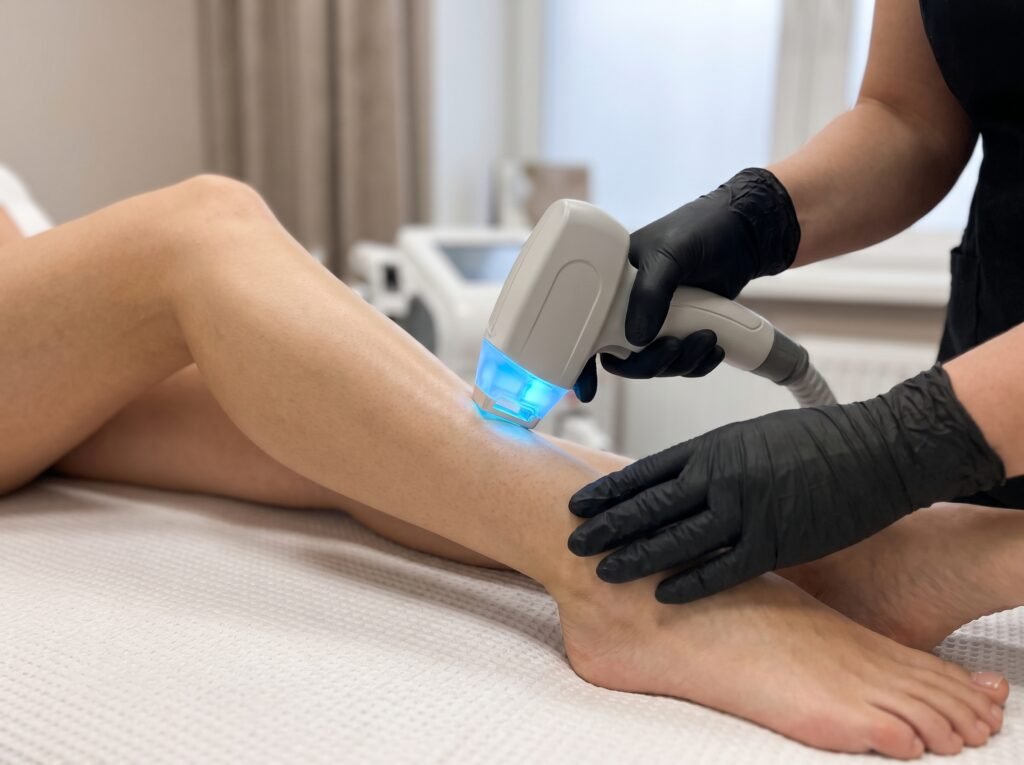
Laser hair removal uses light energy that’s absorbed by the pigment (melanin) in the hair. That energy targets the hair follicle to reduce its ability to grow new hair.
The key thing to understand is timing. Your hair grows in cycles, and the treatment tends to have most effect on hairs that are in their active growth phase at the moment of the session. Because not all of your hairs are in that phase at once, a single session can’t reach all of them — which is why laser hair removal is done as a course of sessions spaced over several weeks, rather than a one-off.
So is it actually permanent?
This is where the wording matters.
- “Permanent removal” would mean no hair ever grows back. That’s a strong claim, and it isn’t one a responsible practitioner will make for everyone.
- “Permanent reduction” is the phrase you’ll usually hear. It means that after a full course, many people find that the hair which does return is finer, lighter and sparser — and that there’s simply less of it.
In practice, a lot of clients are very happy with the outcome and go long stretches without needing to shave or wax. But hormones, age and individual biology all play a part, so some regrowth is possible, and results genuinely do vary.
How long do the results last?

There’s no single number that’s true for everyone, and you should be a little wary of anyone who gives you one. What providers can honestly say is:
- Results tend to last longest after a completed course, rather than after one or two sessions.
- Many people choose occasional maintenance or “top-up” sessions — for example if some hair gradually returns — to keep the area the way they like it.
- Factors like your hair colour, skin tone, the area being treated and hormonal changes can all influence how you respond.
Your practitioner is the right person to give you a realistic picture for your hair and skin, ideally at a consultation before you commit to a course.
What affects how well it works?
A few things make a genuine difference, and a good salon will talk you through them:
- Hair colour and skin tone. Because the light targets pigment, the response can differ depending on your hair and skin. Modern professional systems are designed to work across a range of skin tones, but your practitioner will assess what’s suitable for you.
- The area treated. Different parts of the body can respond differently.
- Completing the course. Skipping sessions or spacing them incorrectly can affect the outcome, because of those hair-growth cycles.
- Hormonal factors. Certain hormonal changes can prompt new hair growth over time, which is why some people need occasional top-ups.
Is it safe, and will it hurt?

Those are the two other questions almost everyone asks — and they deserve proper answers rather than a throwaway line here. The short version: when it’s carried out by a trained, qualified practitioner after a consultation and patch test, laser hair removal is a well-established cosmetic treatment, and most people describe the sensation as tolerable rather than painful. Ask your salon to walk you through their process, your medical history and what to expect.
Questions worth asking your salon

Before you book a course, it’s completely reasonable to ask:
- What results are realistic for my hair and skin?
- How many sessions do you recommend, and how far apart?
- Will you do a consultation and a patch test first?
- What training and qualifications does the practitioner hold?
- Is any maintenance likely afterwards?
A confident, well-run salon will welcome every one of those questions.
The honest bottom line

Laser hair removal isn’t magic and it isn’t a con — it’s a well-established cosmetic treatment that, for many people, leads to a lasting reduction in unwanted hair. Just go in with realistic expectations: think “much less hair, for a long time, with the odd top-up” rather than “gone forever, guaranteed”. Results vary, so the best next step is a proper consultation with a qualified practitioner who’ll assess your skin and hair honestly.
—
Written by Janice Hilton, founder and managing director of Contour Group and a former salon owner. Contour Group supplies professional laser and skin machines to UK salons and clinics, along with the training and qualifications behind them. This article is general information for clients, not medical advice — always speak to a qualified practitioner about your own treatment.