A contraindication is a reason not to carry out a treatment on a particular person, either at all or for now. For device treatments in a salon, the definitive list always comes from the manufacturer’s instructions for your specific machine — not from a general article, a training handout from a different device, or a form you inherited from a previous owner. Where there is a health question behind it, the client’s GP is the authority, not you.
This is the post salon owners most want a straight answer to, and the one where a straight answer would be the most dangerous thing I could give you. So here is what this article can honestly do: explain how contraindications work, where yours come from, and how to handle the moment when you have to say no.
Read this carefully. This article is general information for salon owners. It is not medical advice, it is not clinical training, and nothing below is a contraindication list for any device. No article can give you a complete list. Your contraindications come from the manufacturer’s instructions supplied with your machine, applied through your accredited training, and updated as those instructions are updated. If a client has any health concern, medication or condition they are unsure about, they must speak to their GP — and you should decline until they have. If in doubt, do not treat.
What a contraindication actually is
The word covers two quite different things, and separating them makes the whole subject easier.
An absolute contraindication means the treatment should not be carried out on that person, full stop. A relative — or temporary — contraindication means not now, or not without something else first: a GP’s input, a change of area, a wait, a different approach.
Most of what a salon actually encounters is the second kind. Someone who cannot be treated this month may be perfectly straightforward in three months. That distinction is worth explaining to clients, because “no” and “not yet” land very differently.
Where your list comes from — and only from

Every device is different. Different wavelengths, different energy, different intended use. A contraindication that applies to one machine may not apply to another, and the reverse is equally true. That is why there is no universal list, and why anyone who hands you one should be treated with suspicion.
Yours comes from three places, in this order of authority:
- The manufacturer’s instructions for use, supplied with your machine. This is the document. Keep it where you can reach it, and reread it when it is updated.
- Your accredited training, which teaches you how to apply that document to real people.
- A qualified medical opinion — the client’s own GP — where there is a health question the first two do not settle.
Nothing else outranks those. Not a supplier’s marketing sheet, not a Facebook group, not this page.
The kinds of things manufacturers’ guidance tends to cover
Without turning this into a list — because a list here would be both incomplete and misleading — manufacturer guidance for light-based devices generally groups its cautions into recognisable categories:
- Medication and products that affect how skin responds to light.
- The state of the skin in the treatment area itself — whether it is intact, irritated, recently treated or recently exposed to sun or self-tan.
- Recent procedures in the same area, cosmetic or otherwise.
- Implanted devices or metalwork, depending on the technology.
- Pregnancy and breastfeeding, which most manufacturers address specifically.
- Anything the client is under medical care for, which is a referral point rather than a judgement call for you.
Those are categories to look for in your own manual, not a checklist to work from. Your manual will contain items this article does not mention, and some of what it says will be specific to your device in ways no general article can capture.
How to talk about treatments without straying into medicine
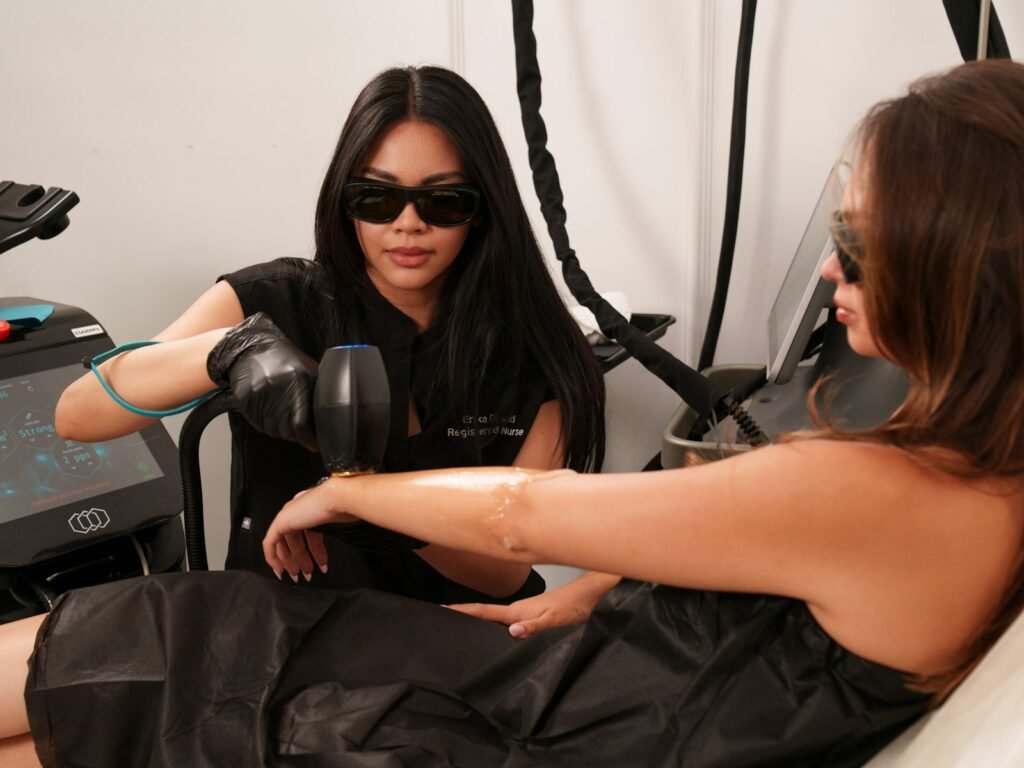
This is where a lot of salons get into difficulty without meaning to, and it connects directly to contraindications.
Device treatments in a salon setting address appearance — unwanted hair, skin texture, uneven skin tone, the appearance of scarring. They do not treat medical conditions, and describing them as though they do is both a compliance problem and a clinical one. If a client’s underlying concern is a diagnosed condition, or something they think might be, the right move is the same every time: send them to their GP first.
Say it warmly and it costs you nothing:
“That’s something I’d want your GP to have a look at before we go anywhere near it. Once you’ve had that conversation, come back and we’ll see what’s sensible.”
You have not lost a client. You have shown one that you know where your edges are — which is the single most reassuring thing a practitioner can demonstrate.
Building the process, not the list
Since you cannot memorise a list, build a process that catches things instead.
| Stage | What it does |
|---|---|
| Health questionnaire | Asks the questions your manufacturer’s guidance requires, in the client’s own words, signed and dated |
| Consultation | You read the answers, ask follow-ups, and make the decision — not the form |
| Decision record | Proceed, defer, or decline — written down with the reason |
| Re-check at each visit | A short “has anything changed?” question, recorded |
| Review cycle | Questionnaire updated whenever your manufacturer’s instructions or training change |
The re-check matters more than people expect. Clients start medication, have procedures and go on holiday between appointments, and almost none of them will think to mention it unless you ask.
When you decline

Have a script, and use it before you need it.
- Be clear that it is a policy, not a personal judgement.
- Say whether it is “not now” or “not with me”.
- Give them the next step — usually a GP conversation.
- Record the decision and the reason, factually and without diagnosis.
- Do not offer an alternative treatment as a workaround for the thing you just declined.
And accept that you will sometimes decline someone who could have been treated safely. That is the correct error to make. The other one is not recoverable.
The short version

- A contraindication is a reason not to treat — absolute, or temporary and reversible.
- There is no complete list in any article, including this one. Your manufacturer’s instructions for your specific device are the authority, applied through accredited training.
- Where there is a health question, the client’s GP decides, not you. Decline until they have spoken to them.
- Salon device treatments address appearance, not medical conditions — keep the language and the referrals honest.
- Build a questionnaire, consultation and recorded-decision process, and re-check at every visit. If in doubt, do not treat.
If you want the assessment side taught properly rather than picked up as you go, the accredited VTCT training we include with every laser machine covers consultation and contraindication assessment in depth — and the device-specific guidance comes with the machine itself. You can also call the Barnsley showroom on 01226 885185 if you would rather talk it through.
—
Written by Janice Hilton, founder and managing director of Contour Group and a former salon owner. Janice helps salon owners add treatments they can deliver safely and defend confidently.